A Fragile World Built on Convenience
The modern world runs on invisible systems — power grids, data networks, supply chains — that most people never think about.
They make life easy. Instant food delivery. Always-on internet. AI tools at our fingertips.
But what happens when those systems fail?
As technology grows more complex and society more centralized, our survival skills have faded. The next collapse might not look like a Hollywood apocalypse — it could be as simple as a long-term grid failure, economic shutdown, or digital blackout.
When that day comes, the survivors won’t be the ones trapped in high-rise apartments.
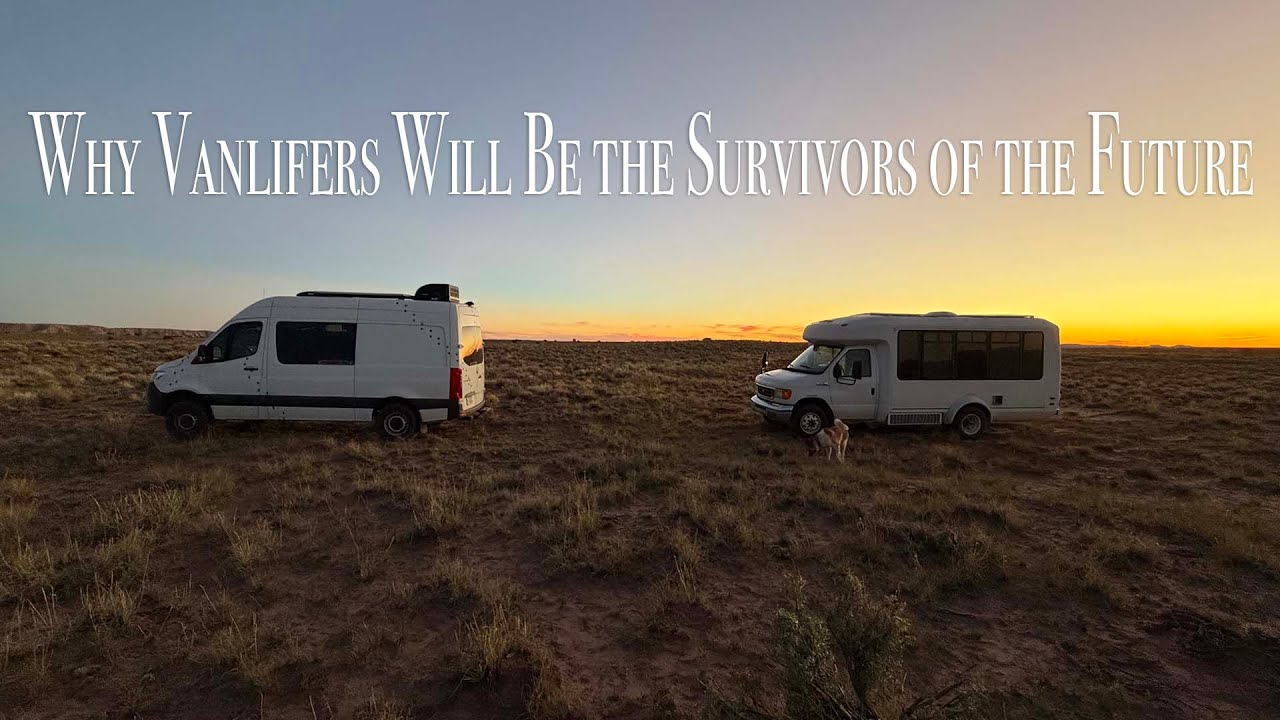
They’ll be the ones already living free — the vanlifers, the digital nomads, and the off-grid wanderers who’ve learned how to thrive with less.
The Collapse of Convenience
We’ve built a civilization addicted to convenience.
But every layer of convenience adds another layer of dependence — on infrastructure, corporations, and technology.
When the power grid flickers out, or the internet goes silent, most people will be lost.
They rely on systems they don’t understand — water that appears with a faucet twist, food that arrives in a box, and energy that comes from somewhere far away.
Vanlifers have already disconnected from that illusion.
They generate their own power, manage their own water, and maintain their own mobile homes.
In doing so, they’ve become quietly self-sufficient — the exact skillset needed in a fragile future.
The Rise of the Mobile Human
Mobility is survival.
While cities anchor people to collapsing systems, nomads remain free to move with the flow of energy, climate, and opportunity.
Vanlifers are the modern pioneers of human adaptability:
- Energy Independence: Solar power, lithium batteries, and mobile power stations.
- Digital Resilience: Remote income streams powered by AI and technology.
- Minimalism: Living efficiently with only what’s necessary.
- Adaptability: The ability to shift locations when resources dry up.
In a sense, vanlifers are the beta version of the next evolution of humanity — part human, part machine, fully adaptive.
Technology and Self-Reliance
AI and automation are reshaping work, creativity, and the economy itself.
While many fear job loss and technological dependency, digital nomads see opportunity.
They’ve already merged the digital and physical — earning remotely while living off-grid.
Solar panels charge laptops. Starlink powers remote work. AI tools replace office jobs.
It’s a decentralized lifestyle where freedom meets technology, not one controlled by it.
When systems collapse, nomads won’t panic — they’ll adapt.
Their homes move, their energy is renewable, and their income exists beyond traditional borders.
The Nomad Philosophy: Less Is More
Vanlife isn’t about escape — it’s about evolution.
When you live in a vehicle, every watt, every drop, every item has value. You become mindful. Minimal. Efficient.
That mindset — awareness, adaptability, and independence — is what makes vanlifers survivors, not escapists.
They live closer to the rhythms of nature and the realities of sustainability.
As society becomes more digital and controlled, vanlifers remind us that true freedom still exists — on the open road, powered by the sun.
Conclusion: The Future Is Off-Grid
If the systems we depend on were to collapse tomorrow, vanlifers would already be surviving — not reacting.
They’ve learned how to harness power, adapt to change, and thrive beyond the grid.
They are the blueprint for a resilient future.
The future isn’t urban.
The future isn’t centralized.
The future is mobile. The future is off-grid.