
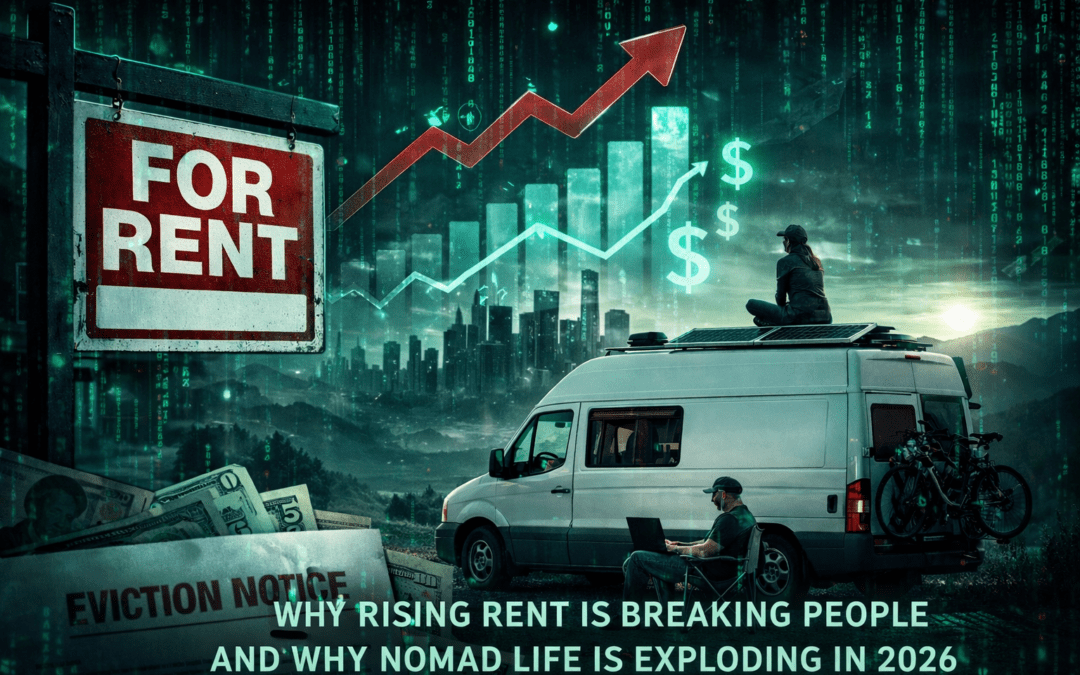
Rent in the United States is no longer just expensive.
For a growing number of working adults, it is financially destabilizing.
As housing costs continue to rise faster than wages, millions of people are finding that traditional living arrangements no longer support savings, mobility, or long-term security. At the same time, job stability is weakening, and more income is earned through contract, remote, or gig work that does not align well with high fixed expenses.
The result is a measurable behavioral shift.
Nomad life, including vehicle dwelling, is expanding not as a trend or counterculture, but as a rational economic response to rising rent and declining housing affordability.
Housing Costs Are Rising Faster Than Income
Housing economists define renters who spend more than 30 percent of their income on housing as rent-burdened (a standard affordability threshold). Today, a substantial share of working Americans fall into this category.
More concerning is the next tier. National housing research shows that millions of renters now spend over 40 percent of their income on rent, placing them in a severely rent-burdened position where financial stability becomes extremely difficult.
When housing consumes this much income, households lose flexibility. Savings shrink. Emergency expenses become crises. Long-term planning becomes nearly impossible.
At that point, housing is no longer a foundation for stability. It becomes a constraint.
Job Instability Makes High Rent Unsustainable
Rent assumes predictable income.
The modern job market no longer provides it.
In early 2026, U.S. employers announced more than 108,000 job cuts, one of the highest January layoff totals since the Great Recession. These losses were spread across technology, retail, and corporate sectors, many of which had previously been considered stable.
Job instability amplifies housing vulnerability because rent requires fixed monthly payments, while modern employment increasingly relies on variable income, contract work, and layoffs. When income drops, housing costs do not adjust downward.
For households already rent-burdened, even a short disruption can trigger eviction, debt, or forced relocation.
Rent Pressure Changes Behavior
When a system becomes unsustainable, people adapt.
Historically, renters responded to rising costs by downsizing or moving to cheaper neighborhoods. Today, that option is shrinking. Rent increases are widespread, and affordability gaps exist even in regions that were once considered low-cost.
As rent consumes a disproportionate share of income, households begin seeking alternatives that eliminate the expense entirely rather than attempting to manage continual increases.
This is where vehicle dwelling enters the picture.
The Rise of Vehicle Dwelling in the United States
Vehicle dwelling (living full-time in a car, van, or RV) has increased as rent-burdened households look for ways to remove housing costs from their monthly budgets.
Current estimates indicate that more than 1.2 million working Americans now live in vehicles. This population includes remote workers, freelancers, laid-off professionals, retirees, and people employed full-time who can no longer justify or afford rent.
For many, vehicle dwelling is not a temporary emergency. It is a calculated decision to trade rent for mobility, flexibility, and cost control.
If You Are Curious, Start With Reality Not Hype

Why Vehicles Become the Housing Solution
Vehicles function differently than traditional housing.
They convert a recurring monthly expense (rent) into a one-time or manageable ownership cost. They allow people to relocate without breaking leases. They provide immediate shelter without requiring approval from landlords or lenders.
When paired with modern systems, vehicles can support long-term living:
- Solar power and battery storage reduce reliance on utilities
- Mobile internet enables remote work
- Compact water and storage systems support daily needs
This combination turns mobility into a form of economic resilience.
Technology Makes Nomad Life Viable
Nomad life today is not defined by minimalism or deprivation. It is enabled by technology.
Advances in solar power, lithium batteries, mobile internet, and remote work have lowered the barriers to nomad life (mobile, location-independent living). People can now work full-time, run businesses, and stay connected without a fixed address.
This matters because it separates modern nomadism from past forms of transient living. The ability to earn income reliably while mobile changes the risk profile entirely.
Nomad life becomes sustainable, not temporary.
Nomad Life Is an Economic Adaptation, Not a Trend
The growth of nomad life is driven less by aesthetics and more by structural pressure.
Rising rent, unstable employment, and technological access intersect to make mobility logical. Eliminating rent lowers financial risk. Geographic flexibility expands job options. Reduced fixed costs increase resilience during income disruptions.
This is not rebellion against society.
It is adaptation to economic conditions.
Mobility Functions as Financial Flexibility
Mobility provides options that fixed housing does not.
It allows individuals to relocate based on job availability, cost of living, seasonal work, or personal safety without renegotiating leases or absorbing relocation penalties.
In an economy defined by volatility, flexibility becomes an asset.
For many people, nomad life is not about travel. It is about optionality.
Community Replaces Institutions
Contrary to popular assumptions, nomad life does not result in isolation.
As traditional housing and labor institutions fail to meet affordability needs, informal nomad communities emerge to share information, resources, and risk. Online networks and in-person gatherings facilitate knowledge sharing around safety, income, maintenance, and locations.
Community fills the gaps left by systems that no longer scale.
What to Understand Before Transitioning
Nomad life requires preparation and responsibility. Key considerations include:
- Power systems (solar and battery capacity)
- Reliable mobile internet for work
- Vehicle maintenance and emergency funds
- Legal considerations around parking and residency
- Income stability through remote or flexible work
Understanding these factors early reduces risk and increases sustainability.
Why Mobility Is Becoming a Financial Survival Strategy
Rising rent is not a personal failure.
It is a structural problem.
Nomad life is expanding because it solves that problem in a direct, practical way. It reduces costs, increases flexibility, and restores control in an environment where traditional housing no longer guarantees stability.
People are not opting out of society.
They are opting out of a model that no longer works.
For those exploring this path seriously, understanding the systems, tradeoffs, and realities matters more than inspiration.
That clarity is where sustainable freedom begins.
You Don’t Have to Do This Alone
Nomad living can be empowering, but it can also feel isolating, especially in the beginning. Questions come fast. Doubts show up at night. Some days you need advice. Other days you just need to know you’re not the only one figuring this out in real time.
That’s why Nomad Syndicate exists.
It’s a growing community of people living on the road, preparing for it, or rebuilding their lives through mobility. Some chose this lifestyle. Others were pushed into it. All of us are learning as we go.
Inside the Nomad Syndicate communities, you’ll find:
- Real conversations about living in vehicles
- Practical advice on water, power, parking, and safety
- Support during breakdowns, setbacks, and transitions
- People who understand the sacrifices and the freedom
- A place to ask questions without judgment
Whether you’re just starting, already living on the road, or considering your next move, community makes this life sustainable.
Join the Nomad Syndicate
- Facebook Group for daily discussion and support
- Reddit Community for open conversation and shared experiences
- Discord Server for real-time chat, resources, and deeper connection
This lifestyle works best when knowledge is shared and people look out for each other.
You’re not behind.
You’re not alone.
And you don’t have to figure this out by yourself.
Welcome to the Syndicate.

Frequently Asked Questions About Rent and Nomad Life
Why does rising rent lead people to nomad life?
Is vehicle dwelling becoming more common?
Is nomad life legal?
Does nomad life actually save money?
Can beginners realistically make this work?

